The Power of Many Minds
The Science of Collective Intelligence
Every experienced business leader knows instinctively what decades of research has now confirmed: the best decisions emerge from the collision of different perspectives. A room full of people who think alike may reach consensus quickly, but they're far more likely to miss critical blind spots, overlook emerging risks, and converge on comfortable rather than optimal solutions. The evidence for diverse team performance has grown increasingly compelling over recent years.
Research by Cloverpop, which analysed approximately 600 business decisions made by 200 different teams, found that diverse and inclusive teams make better business decisions up to 87% of the time. Perhaps more striking, decisions made and executed by diverse teams delivered 60% better results than those from less diverse groups. The study also found that inclusive teams make decisions twice as fast, with half the meetings—a finding that challenges the assumption that diverse groups sacrifice efficiency for quality.
The Boston Consulting Group and Technical University of Munich took a different angle, examining the relationship between management diversity and innovation. Their research across 1,700 companies in eight countries revealed that organisations with above-average diversity on leadership teams reported innovation revenues 19 percentage points higher than companies with below-average diversity. These companies also enjoyed EBIT margins 9 percentage points higher than their less diverse counterparts. The mechanism isn't mysterious: diverse teams consider more options, challenge assumptions more readily, and are more likely to spot opportunities that homogeneous groups miss.
The Lonely Reality of Running a Business
For SME owners, the benefits of diverse thinking can feel tantalisingly out of reach. Research by Be the Business found that close to one in four SME leaders feel lonely making decisions about their business, with more than a quarter shouldering responsibility and decision-making entirely alone. A separate study found that 73% of SME owners admit to feeling lonely, with three-quarters stating they often don't know who to turn to when things get tough.
This isolation isn't merely uncomfortable—it directly undermines decision quality. The same research found that eight out of ten SME leaders believe a fresh or outside perspective would help them make better business decisions. They specifically cited access to subject matter experts, online learning sessions, and groups of business advisors as resources that would improve their strategic thinking. The desire for diverse input exists; what's missing is practical access to it.
The consequences compound over time. Business owners working in isolation often fall victim to confirmation bias, seeking out information that supports their existing views rather than challenging them. They lack the cognitive friction that comes from defending ideas to sceptical colleagues. Without diverse perspectives, they may pursue strategies that feel right but haven't been stress-tested against alternative viewpoints. McKinsey's 2023 'Diversity Matters Even More' research found that companies in the bottom quartile for leadership diversity were 66% less likely to outperform financially—up from 27% in 2020, suggesting the penalty for homogeneous thinking is actually increasing.
Replicating the Boardroom Dynamic
The emerging field of multi-agent AI systems offers a compelling solution. According to Gartner, 75% of large enterprises will have adopted multi-agent systems by 2026, while BCG projects these collaborative AI architectures will generate $53 billion in revenue by 2030. The principle is straightforward: rather than relying on a single AI assistant, multi-agent systems deploy multiple specialised AI entities that collaborate, debate, and refine solutions together.
IBM describes multi-agent collaboration as enabling 'emergent collective intelligence'—sophisticated problem-solving that exceeds the capabilities of any individual agent. Just as human teams benefit from diverse expertise and perspectives, AI teams can be configured with different specialisations and even different 'personalities' that naturally generate the productive tension that leads to better outcomes. A cautious financial perspective can challenge an aggressive growth strategy. A customer-focused viewpoint can balance operational efficiency concerns.
For SME owners, this creates an unprecedented opportunity. Where once accessing diverse strategic perspectives required assembling expensive advisory boards or engaging multiple consultants, synthetic teams can simulate similar dynamics at a fraction of the cost. Early adopters report up to 30% reduction in operational costs and 35% increases in productivity from multi-agent implementations. The technology doesn't replace human judgment—it augments the owner's thinking by exposing decisions to scrutiny from multiple angles before they're finalised.
Building Your Virtual Advisory Team
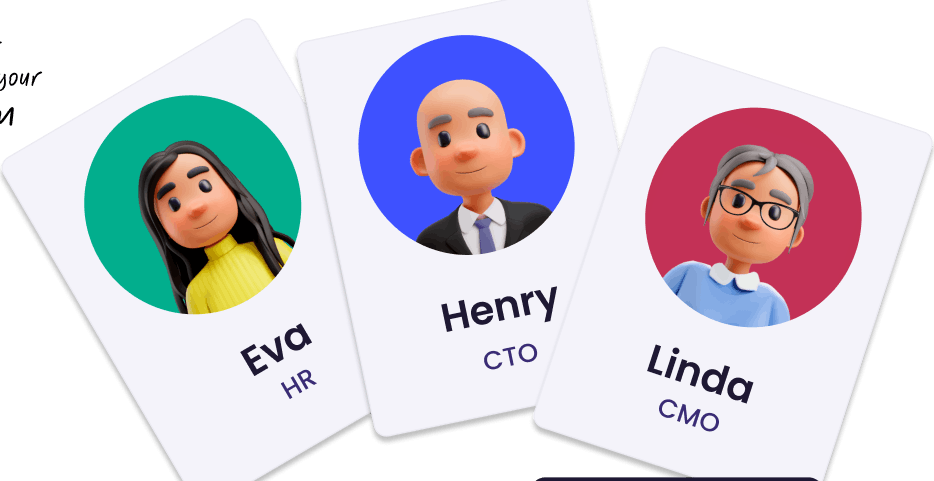
Consider what a well-constructed AI team might look like for a typical SME. One agent might embody financial prudence, instinctively probing cash flow implications and return-on-investment calculations. Another might represent customer advocacy, constantly asking how decisions affect client experience and satisfaction. A third might bring competitive intelligence, considering how rivals might respond to strategic moves. A fourth could champion operational efficiency, ensuring that ambitious plans remain practically executable.
This mirrors how high-performing human teams function. Research published in the Journal of Organizational Behavior found that teams combining both compositional diversity (differences in backgrounds and experiences) and informational diversity (differences in knowledge and perspectives) demonstrate 63% better problem-solving capabilities than teams with only one type of diversity. The key insight is that it's not diversity for its own sake that drives performance—it's the productive interaction between different viewpoints that generates superior solutions.
Deloitte's research on inclusive leadership reinforces this point: leaders who master traits including commitment, courage, cognizance of bias, curiosity, cultural intelligence, and collaboration are 17% more likely to create high-performing teams and 20% more likely to help their organisations make better decisions. An SME owner interacting with a well-designed AI team can develop these same capabilities—learning to consider multiple perspectives, challenge their own assumptions, and synthesise diverse inputs into coherent strategy.
From Isolation to Collective Intelligence
The shift from solitary decision-making to synthetic collaboration represents more than a technological upgrade—it's a fundamental change in how SME owners can approach their most challenging strategic questions. The research is clear that diverse teams outperform, that isolation undermines decision quality, and that most business owners hunger for outside perspectives they currently can't access.
AI teams won't replace the value of trusted human advisors, genuine mentorship, or the irreplaceable insights that come from lived experience in specific industries. What they can do is ensure that no business owner need ever make a critical decision in complete isolation. They can provide the cognitive diversity that research shows drives better outcomes. They can challenge assumptions, surface overlooked risks, and pressure-test strategies before resources are committed.
For the SME owner who has always known, deep down, that they don't have all the answers—but who has lacked the resources to assemble the diverse team they need—synthetic advisory teams represent a genuinely new possibility. The science of diverse team performance has been clear for decades. What's changed is that the benefits of collective intelligence are now within reach of every business owner willing to embrace them.